Wednesday, February 13, 2013

Puno — A cultural experience from start to finish.

We left Cusco by bus to our next stop — Puno, which is an unassuming town on the shores of Lake Titicaca, the highest and largest navigable lake in the world. As we entered Puno, it seemed at first to have little character, dusty and forlorn. But what awaited us was a cultural experience we could not have dreamed of.


We were in Puno for two specific reasons: to experience the Candelaria Festival (Dance competition and local festival) and to visit three islands on Lake Titicaca.


We arrived Friday afternoon as the town was setting up for the celebration. Saturday morning there was a special outdoor mass at the main Cathedral, which we attended, followed by a procession of the Virgin Mary around the square. Several streets were blocked off as the dance troops created iconic art representative of their local home. They used a base of what we think was sawdust and plaster and water tinted with food colouring and then adding flower petals for decoration. Large groups were involved, some drawing the outlines of the designs, others spreading colour and brushing it into place. The results were spectacular.


In the streets, hawkers were selling raincoats, sun umbrellas, ice cream, folding chairs and an assortment of local food to the crowds that were accumulating. We also started to see dance troops arriving in full costume for the dance competition that was to begin at 7:30 am Sunday morning in the local stadium, with 80 troops listed to perform.


We arrived at the stadium Sunday morning around 9:00 am. On the way, we witnessed many of the troops that had completed their performances dancing in the street, or settling in for a day of drinking and eating along the main street outside the stadium. Even at 9:00 am, the scene was almost overwhelming.


The first weekend of the two-week festival was more of a local affair. Although there were tourists in town, primarily we sat with local townspeople in the stadium to watch the large dance troops perform. The troops have anywhere from 50-200 participants, each dressed in their local costumes. Almost all the troops included a band of bamboo wind instruments as well as percussion instruments of some kind. Each performance included an introductory dance to get them all out on the field and then another synchronized dance routine taking them all over the stadium field twisting and turning in full regalia. We were out of breath just watching them run around in heavy costumes at 13, 000 ft!

The locals were better prepared than we were for the weather and the long day in the stadium stands. Many came with picnic lunches, blankets and umbrellas. But as we witnessed the day before, hawkers were out in full force to sell you anything you forgot to bring with you. Women with bags of cooked corn, fried cheese, bread, fried trout, big hunks of cooked ham, guinea pig and chicken, chopped salad and cut limes were setting up for the lunch crowd. You could buy litre bottles of soft drinks with paper cups, ice cream, and snacks, plastic sheets or rain ponchos. Anything your heart desired was at close reach.


We took a break from the stadium after a few hours to take in the street scene. By then, thousands of dancers were in the streets, eating, drinking and dancing. A beer garden was set up, as well as endless food stands serving fried meats, chopped salads, and pressed or iced fruit juices. We had never seen anything like it.


That night there was a procession through town of all the dance troops and a party that went on until all hours of the morning. We could hear the drums in the distance from our hotel room well into the night.
When we woke up the next day, it was as if it never happened. The beautiful street art had been swept away. The dance troops had all left town. Puno had returned to its quiet self. But just an hour away, on the islands of Lake Titicaca another cultural experience awaited us.

Monday, February 11, 2013

The living pueblos of the Sacred Valley

Visiting the Sacred Valley is not all stones and terraces. Near the archeological sites of Pisac, Chincherro and Ollaytaytambo, are living Inca villages by the same names; designed in the same way they were in Incan times, using the same barter systems for trade, and the same system of moving water through their streets. It is a great experience to see the ruins and then see a living example of how it once was.


We stopped to visit the local market in Chincherro where women sold their wares to tourists and bartered their produce between themselves. We also watched a demonstration of how the local people use natural elements to dye the wool they weave and knit into hats and shawls and sashes for their local costumes. The young woman who gave the demonstration had a great sense of dry humour in both Spanish and English which made it very entertaining! There was the hope, of course, that at the end of the show we would buy souvenirs, and most of us did if only to support the local economy. Although they use the barter system as much as possible, there are things they need to buy in the big city and having cash is still a necessity.


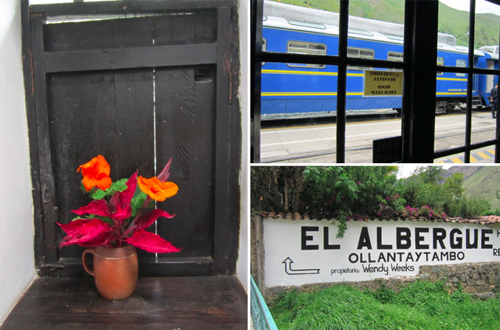
We spent the night in Ollataytambo, a very charming town, on the way back from our visit to Machu Picchu. We stayed in a wonderful Hostal situated right at the train station. And I mean right beside the tracks. We simply got off the train and rang the bell at the door of our Hotel (El Alberque)! The place is owned and designed by Wendy Weeks, an artist from the US who settled in Ollaytaytambo. We also climbed to the ruins of Incan granaries we had viewed from the official archeological site and walked the original narrow Inca streets of the town. There we watched the clear water flow through the gutters on each side of the narrow streets, clean and fresh as in Inca times. No garbage or sewage to be seen. Our guide a few days before had explained that, to the Incas, water was sacred. Without clean water there would not be life. In today’s pueblos, in the homes built on the foundations of their ancestors’ dwellings, these people follow the same practices.


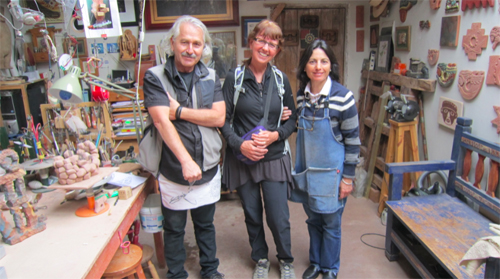
With the help of a local man in Urubamba we found and visited the studio of Pablo Seminario, a very interesting artist who has been creating ceramics using the methods of the Pre-Incan and Incan cultures. We were given the chance to visit with him and his wife in his workshop and discuss his process. After a short discussion about where he found his inspiration, he laughed and told us, his work could be called “Post-Inca”! One of his staff took us on a tour of the studio and we watched the crew of talented artists he employs throw and hand build pieces, apply coloured slip designs to them, and later burnish the painted pieces with smooth stones (as he believes through his research that the ancient people of this area would have done). We saw the large kilns the pieces are fired in and also admired the finished pieces in the Gallery Seminario.

The studio is also home to his extensive collection of Pre-Incan and Incan art that he studies for inspiration. His wife told us he has visions in dreams that inform his work. From talking to him, you got the sense he was a very special and spiritual man trying to keep the techniques of his ancestors alive. And of course there is the business side of things. We read that his inspired works can be found all over Peru and even on the shelves of Pier 1 Imports!

We travelled between these villages by combi (small local buses) or collectivos (shared taxis). In all cases we were treated fairly and felt very safe and at home with the rural Peruvians we had the chance to share a ride with. When we needed help, there was always someone to give us directions or even escort us to our destination. Often times we were speaking different languages, but the job got done.

Our visit to the Sacred Valley left us with a better understanding of the culture and heritage of this region. In the middle of it all we took the train to Aguas Calientes and the short bus ride to Machu Picchu where we walked through (as the heavens rained down on us), one of the most intact Inca cities in Peru. With that experience under our belt, our trip to the world of the Incas was nearly complete.


If the stones could talk …

There is much written about the Incan Empire. How large it was, how short lived it was, the customs and the culture of the people who built the huge stone temples, farmed the endless system of terraces and built the roads from Cusco in four direction. But in reality — it is only theory, because all that remains of this great empire and those that came before — are polished interlocking stones.

There is no written language to give us clues, only the decorations on shards of pottery found during archeological excavations or robbed from the graves of their well preserved mummies. And until recently, much of the pottery found all over Peru was not even correctly classified. Interestingly, there’s a linear evolution in the styles of pottery. The motifs found on Pre-Incan and Incan sites make it clear that the early peoples of Peru worshipped similar gods, ate similar foods, and led similar lifestyles. But many pieces of the puzzle are still a mystery.

For instance, it is hard to imagine how the Inca temple at Sacsayhuamán in the shape of a puma, which reportedly took over a hundred years to build, could have been accomplished without any written or at least symbolic plans that could have been passed down from work manager to work manager to complete the work. Or how the enormous stones were moved into place, or even the simple question of how they cut these large stones.


Some things are easier to piece together. The extensive terraced mountainsides surrounding every archeological site in Peru clearly indicate that the Incan civilization, and the cultures preceding it, were serious farmers. The results of their collective agricultural experimentation have provided the modern world with thousands of varieties of potatoes and other tubers. Their knowledge of micro-climates and how to utilize them for different crops was phenomenal.


I am not an historian or an archeologist, but there are clear links to the past that we have witnessed in the five weeks we have travelled through Peru visiting archeological sites and the towns, villages and cities that are within, alongside and on top of the stones laid hundreds of years previous. You can feel the connection to their rich heritage in every aspect of their lives. The deep connection to mother earth is evident in the way they rotate their crops and the way they use the barter system to manage their agricultural work and exchange of goods. From what we have learned, the many cultures that lived here through the last couple mellenia were communal in nature, and we have witnessed that modern day rural Peruvians still follow this model.


It is clear when viewing the clean shapes of the interconnecting stones at any of the archeological sites in Peru that the people who built them were very precise and organized. They planned their cities with geometrical precision. Their systems for moving water were so well planned that they are still in use today. They worshipped the earth and the sun and took great care not foul that which provided them with life. Modern day Peruvians follow the same traditions. Their streets and their homes are spotless. Their fields are beautifully planted. They live in harmony with nature leading simple lives. They work hard and celebrate hard with respect and recognition for Pachamama and Patchatata that make their lives possible.


So when you view these photos taken of what looks like piles of stones, consider the huge contribution the architects of Cusco, Machu Picchu, Sacsayhuaman, Ollantaytambo, Pisac and endless other Incan and Pre Incan cities had on the culture of modern Peru.