Tuesday, February 14, 2012

Its the final countdown


There were several times during the last 70 odd days, where this song was requested (we could plug in an mp3 player into the audio system in our bus). There was always a mixed reaction when the request was made and many times there was overwhelming disapproval, but when we were rolling into Chennai, where we would say our goodbyes to a large part of the group, there was not a peep and even a few tears.

Now that we have left Calcutta behind, and have begun the last leg of our India trip, I can’t get this tune out of my head.

10 days left — and for all intents and purposes, we have left India already. We arrived yesterday in Darjeeling, which was part of Nepal until India Independence (or around that time), and the people here not only look Nepalese, but they speak Nepali. There are prayer flags everywhere and even the architecture changed dramatically. But I am getting ahead of myself.

We spent three days in Calcutta, and I feel at this point, I could argue with Ajay as to where the real soul of India lies. I put my bets on Calcutta.

We were all dreading arriving in Calcutta. Everyone had the impression that it was a really run down, dirty, impoverished, malaria infested city with little appeal for a three day visit. But from the moment we arrived at the train station and stood in line for our prepaid yellow cabs, we realized that this was a very special place. Aside from the many tourist attractions, including The Mother House (the first hospice Mother Theresa opened to help the dying poor of Calcutta) and all of the subsequent charity homes founded by her, the Victoria Monument, India Museum, Marble Palace, the Howrah Bridge (The third longest cantilever bridge at the time of its construction in the world), various markets and modern shopping malls and endless other gems, there was the vast city itself to explore and appreciate.


The Mother House

Victoria Monument

Calcutta lives and breathes its poverty and its riches. There are such multitudes living in each sphere that one really does not bother with the other. They seem to live in complete harmony (or at least it seemed that way to us). Our hotel, the Comfort Inn (no, as you’ll note from the pics, not at all related to the U.S chain) was situated in what I can only call a moderate slum of Calcutta. When our yellow cab dropped us off in front of it, we were more than a little skeptical of what we would find inside. The exterior was crumbling and the storefronts on all sides looked worrisome, but within an hour we were settled in our pleasantly appointed room on the second floor and started to discover the neighbourhood.

Doesn't look too comfortable does it?

As each day turned to night on our street, the sidewalk converted to a makeshift hostel for the large number of people who call this home. Street people’s laundry hung from electric lines and children bathed from the flowing tap in the street. Friendly card games were ongoing on the sidewalk, and in the morning, you can watch men getting shaved by the resident barbers on street corners, shoes being shined, more bathing, and meals being prepared by street vendors. Rickshaw drivers slept in their rickshaws. There were small fires on the sidewalk to keep warm or to heat up chai. At all hours, someone is digging a ditch or moving bricks around — all in what looked to us, like perfect harmony. We walked through their makeshift homes on the way to and from all of our activities, and there was never a feeling of being unsafe. In fact, they hardly noticed us. If we needed information they were more than happy to help, otherwise they let us be and we tried to do the same.

For that reason, I really have no pictures of these phenomena or the people we saw during our short visit. It just didn’t feel right to intrude on their privacy.

Just a short walk from our hotel (less than 1k) was a very modern Calcutta street (Park Street) with shops, restaurants, banks and modern middle class Indians shopping, sipping cappuccino and eating fancy pastries. Two worlds side by side. It was so interesting and so India.


This fancy bathroom fixture shop was actually on our street with people sleeping on the side walk out front.


For me it was the best way to end our trip in this incredibly diverse country. The city is so real. No pretensions. What you see is what you get.

We boarded the second-class AC (air conditioned) sleeper train at the new Kolkata (Calcutta can be spelled both ways) train station at around 9:00 pm headed for Siliguri. This was not like any other sleeper train Marc and I had been on and at first I was very apprehensive. There were no cabins, just six beds facing each other (three and three) and then another six beds all the way down the car. During the day, one bed on each side is lowered so that three people can sit, and at night it turns into a massive dormitory. Most Indians board with an overnight bag, but the 10 of us had all of our backpacks and duffle bags, day-packs and snacks for the overnight journey.


Did I mention there are no racks for luggage? Or that Indians seem to be in a huge panic to board trains and like to push and shove from both ends of the car? Or that we were not all in consecutive bunks and that there were at least three Indians that would be sleeping with us?

You can't tell, but Rosie is on the bunk on top and I my bunk is under Marc. Just to my right, there were three other bunks for Anja, Bob and Jeremy!

It took about an hour, but we managed to shove 80% of our luggage under the seats and convince three Indians to switch seats so we were all more or less together. The other 20% of our luggage somehow transformed into pillows or foot rests. Once we finally got comfortable, and killed a couple cockroaches, most of us remarkably fell asleep and slept more or less soundly until 7:00 am when we got organized for the escape from the train, with all of our luggage without being trampled by the Indians.

At this point, having arrived in Siliguri and having met our jeep drivers for the trip to Darjeeling, I am not sure any of us knew how perfect it was to have experienced this overnight train at this particular moment, and to have visited Calcutta as our last major Indian city. Within hours, we had left everything we knew as India behind. The scenery changed, the people had changed, the temperature had dipped 20 degrees, and even the language had changed.

10 days and counting. It’s definitely the final countdown.

(As a footnote, the Dragoman truck we have been waiting for since the beginning of the trip has finally been released from customs in New Delhi. Since the truck’s papers are in Al’s name, he needs to be in New Delhi to sign them and drive the truck to the Nepalese border to pick everyone up for the last three days of the trip. Since we are flying to Singapore from Siriguli and will not be crossing the border into Nepal with the rest of the group, we had to say farewell to Al in Calcutta. He is an amazing person and a born leader and we will really miss him. I know there will be many times once we are on our own organizing our way through Singapore, Malaysia etc, that we will wish we had Al along to help us problem solve and get things done. We will miss his great stories and his way of getting results in the most stressful situations. And, of course, his signature statement “No worries guys? Cheers!”)


Saturday, February 11, 2012

Orissa Tribal Tour—the soul of India

When we met Ajay, our local guide in Visakhapatnam, he was quick to congratulate us on visiting all of the biggest monuments and beautiful sights his country has to offer, but now he assured us, we would be experiencing something quite different. Now we would be entering the soul of India — Orissa.

He imparted these words of wisdom with his signature welcoming smile and eyes glistening with enthusiasm. He soon shared with us, that he had spent most of his life in the jungles of Orissa with his father who was a teacher of the tribal people. For this reason, this area and these people are near and dear to his heart. But he further explained that during his lifetime he has witnessed the effects of the government’s attempts at (so called) improving their standard of living, by simplifying their lifestyle and attempting to settle the wandering tribes into permanent villages. As he described these government intrusions, we could see the sorrow creep into his expression. We would see for ourselves soon enough that the changes forced on these indigenous peoples have altered their way of life irreparably.

Our five days in Orissa were filled with mixed emotions about the tour itself and the ethics of the company Dragoman hired to arrange our visits. We were travelling in a caravan of three jeeps and felt at times like we were on a human safari. What we were looking for was elusive and when we found it, it was fleeting. Ajay did his best, but we felt at times that he was given an unobtainable task.

The distances between villages were significant and it always seemed like we would arrive just after the tribal women with the signature jewelry and woven clothing we were meant to visit, had left for the market. If we arrived at the market, we soon found the tribal people were up in the hills for a special festival. When we entered a village, we often feet unwelcome. Children were asking for biscuits and chocolate, because that was what was usually provided in order to allow tourists like us to take photos. Something just wasn’t right.


Ajay filled us in on the some of the more difficult facts, such as how the government had provided asbestos roofing tile free of charge to the villagers so that they would not have to re-thatch their roofs, with no attempt to explain to them that they were using materials that are banned in most countries due to their carcinogenic properties. We also learned that alcohol abuse is widespread among a population of young men who carry a hatchet and a knife as part of their tribal dress, leading to violence.

Not a pretty picture.

But even with the difficult facts and frustrations of long drives, we did get a glimpse into the life of these beautiful people. I tried very hard to make a connection and to let them know how much I appreciated the stunning patterns of their saris and the glitter of the gold in their nose rings and earrings. We managed to communicate through hand gestures and smiles, which go a long way when it is the only common language available. Although I know they have seen themselves many times in the cameras of the tourists that bother them day after day, they still giggle each time and seem to get some kind of pleasure out of seeing themselves or their children in my viewfinder. It somehow helped me feel ok about intruding in their lives in such a crass way. But I know I was only kidding myself.

Each evening before dinner Ajay filled us in on the traditions, family structure and history of the tribes we would be visiting. It was a lot of information and I can’t remember it all well enough to pass it on, but this link will give you some insight.


In addition to the cultural side of the tribal area, we were also privy to state politics. Orissa will be having an election in a day or two and everywhere we went we were bombarded with election propaganda. Since most of the tribal people are illiterate, each party is represented by a symbol. It took us a day or two to figure out why all walls in most villages had painted slogans on them along with pictograms. “Vote for” accompanied by a drawing of a teapot, or a hand, or a seashell. Then there were small trucks with loudspeakers blaring out political party platforms travelling all through the state at all hours of the day and night. Each truck bears the colours and the symbol of the party. Ajay was quick to comment on the propensity of the incumbent party to quickly pave roads or make any quick fix upgrades to assure the villagers’ votes in the upcoming election. We also witnessed a lunch catered by a political party in one of the villages we visited. Nothing like a good meal and alcohol to assure a trip to the ballot box!

In spite of the difficulties, we did have a lot of very positive experiences on our tribal tour, that will stay with us always. Here are some excerpts.


… We stopped our three jeeps at the entrance to a bustling fruit and vegetable market. Ajay walked us through, pointing out the many items we could not identify or had never seen before. We tasted rice alcohol, nibbled on mysterious nuts and tasted hand made sweets. Many of the women selling goods and/or shopping for them had triple nose rings. This Ajay told us this identified them as belonging to one particular tribe. In many cases their goods were neatly grouped in circular piles. Ajay explained that these items were priced by group rather than by weight. The people were as colourful as their wares for sale and we thoroughly enjoyed our wander through the first of several markets we visited on the tour.


… We were met by the Chief of the tribe, dressed in a beautiful lilac Salwa (long man dress and skinny pants) at the entrance to the village. He was a very handsome man, and we could see right away that he was well respected by the villagers. He accompanied us through the village, and as his guest, we were very well received by the local people. Ajay translated if the Chief explained something specific about the tribe or the village and added information as we visited different areas and saw different aspects of their daily life. Then we took a two-hour walk through the jungle to reach a second village on the other side. The views and the flora and fauna were exquisite and we were all very happy to be walking in nature instead of driving quickly around it in our jeeps.


As we approached the second village, I took a look around and marveled at the beautiful scenery. “Do the villagers ever travel to other parts of India?” I asked Ajay. “They do, but only to neighbouring villages when they marry into different tribes.” he quickly replied. “In that case,” I said, shaking my head and once again gasping at the beauty of the terraced rice paddies, lakes and the tree covered volcanic cinder cones behind them, “they must think the whole world looks like this!” I couldn’t help wondering if it might lighten their load if they knew how lucky they were to breathe in this fresh air and have such a beautiful piece of this earth to call home.


… We were met by a very interesting looking man with dreadlocks tied in a bun on his head, who it turned out, was the tribal spiritual leader. He walked with us through the village and at the end of our tour, gathered all of the women and children into a central area. He then performed a tribal dance while they accompanied him with their singing. As we left the village they all gathered to bid us farewell with a wave and a smile.


… When we walked into the village, we happened on a Bonda tribal elder being fitted with all of her traditional jewelry. Some of the Bonda women’s identifying attributes are their large wooden earrings, heavy neck and wrist bangles, shaved heads and beaded headdresses. We were told that only the elders of the tribe still follow these traditions, and we saw for ourselves that the young married women and their female children were dressed in modern Indian saris. When we crossed to the other side of the village, we saw a large group of villagers dressed in traditional garb (men and women), preparing for a performance. We assembled to one side of the open space and were treated to an amazing traditional dance performance. The women had large peacock broom like props and the men played traditional instruments. At one point in the proceedings, Marc was invited to join in, and before long many of us were up dancing. It gave us an opportunity to participate and enjoy our interaction with these people and their traditions, although we were quite aware that they only don these beautiful costumes for very special occasions — and to please westerners.


… The first thing we saw was a woman sitting on the floor with a basket of silk cocoons, pulling a thin thread, and rolling it on her bare oiled thigh in a soothing rhythm onto a spindle. Behind her was a man sitting at a loom, weaving the beginnings of a full-length sari. This was a co-operative village of weavers who spin, die and weave their own fabric. We walked through the village to see how the whole process worked from start to finish. As we experienced in Varanasi, hand weaving of fine intricately patterned cloth is a painstaking and extremely time-consuming craft. At the end of our visit we were served the obligatory chai tea and presented with the finished products for our viewing (and purchasing) pleasure. I already have three scarves in my bursting travel bag, but I couldn’t leave without a tangible memory of these people and their handiwork.


Each time I wear my beautiful olive and black silk/cotton blend scarf, I will remember the small woman sitting in lotus position rhythmically pulling natural fibres out of a cocoon, that would later be dyed specifically for the pattern in my scarf. And even more incredibly, another member of this tribe would then thread the loom and work for days sitting behind it to complete this beautifully designed and carefully crafted piece of fabric.


… The members of this tribe use a wax relief method to create intricate metal folk art originally used for ceremonial purposes. Typically the subjects would have been animals such as cows, elephants or goats. These sculptures would be left on ceremonial altars as kind of a perpetual sacrifice. Over time, the sculptures became popular with tourists and they widened their focus to include some jewelry and other folk art pieces. I tried very hard to find something small to buy, but everything was just too heavy. I was so intrigued with watching the process of how they make these works of art, that I completely forgot to take photos. Internet to the rescue, I have found some examples!


… We walked into a thatched roofed building and found several men sitting next to what looked like a wagon wheel with an axle. But lined up beside each wheel were rows of drying pots so we soon realized that they must have been potting wheels. The thick wooden dowel in the middle (the thing that looked like an axle) fit into a hole in the ground and by manually grabbing onto each of the spokes in the wheel and getting momentum going, the wheel began spinning like a top. One of the villagers offered to show us how a pot was made and we were mesmerized as he opened a large black bag and grabbed a large handful of dark clay. He kneaded it a few times to get all of the air bubbles out and threw it on his spinning wheel. Within minutes the lump of clay transformed into a large perfectly shaped vessel. His hands and a leaf were used to perfect the lip of the vessel and a wire was used to cut free the completed pot from the spinning wheel. Ajay translated as the man explained that they take orders from other villages, for both ceremonial vessels and day-to-day kitchen and cooking ware. As we left we admired the rows of pots drying with new admiration after watching how they were made from the clay these men gathered themselves and prepared.


… We walked down to the edge of the marsh and seated ourselves in two canoe-like boats, each steered by a man with a bamboo pole and accompanied by a local bird watching guide. For an hour we glided through the Mangalajodi nature reserve viewing the largest number of birds we have ever seen in one place (My camera is not good at capturing wildlife but you can take my word for it that we saw hundreds of birds every minute!) The most spectacular part of this place was that until recently it was known as “poachers village”. Through the help of an organization called Wild Orissa, the “poachers” have been trained as bird watching guides and now make their living through tourism rather than killing birds. Normally the lake hosts over 150,000 birds of 200 species during the peak season of which at least 80 are migratory birds. It felt like we saw all of them in one short hour. This was our last experience in the tribal area and it was a wonderful way to experience the nature and tranquility of, as Ajay describes it, the soul of India.


Thursday, February 2, 2012

Riding the rails

The next leg of our trip has begun. For the last three days we have been riding the rails, making our way to the highlight of this part of our trip — Orissa Tribal areas. Tomorrow we will be picked up by our local guide and we hope three fairly comfortable SUV 4-wheel drive vehicles.


In the mean time we have thoroughly enjoyed our three rides on the train. Our journeys have taken us to towns none of us can pronounce or remember. They are not on any tourist itinerary, and we have been the only Westerners in sight on the train platforms or in the towns themselves. This always makes for interesting interactions with the local people. The first question out of their mouths is always "where are you from?" After a few sentences we are bonded. When they move on in line or leave the station they always give one of us a tap on the shoulder to get our attention and wave goodbye. There is always an opportunity for a photo and their giggles as they look at themselves in my camera. This happens over and over again, but it never really gets old. A small connection with the local population that takes very little effort, but feels really good.


Interestingly, as we move closer to the tribal areas, the cities seem to be more developed, cleaner and more Western. We continue to be surprised by the many faces of this country. We just had dinner in a beautiful mall offering a full food court (including Subway and Baskin Robbins), Pizza Hut and KFC. The shops were like in any mall. Clothing stores with both Western and Indian fashion, an Indian version of Future Shop and really anything you would find in the West. We are always ready for a break from Indian food, so even Pizza Hut feels like a gourmet meal!


I think we have one more night in civilization and then we are off on a great adventure visiting local markets, meeting the tribal people, viewing their handicrafts and seeing how they live. This part of the trip was meant to be all wild camping. But the truck is still in customs somewhere in India so Al has arranged hotels for us. It will mean a bit more driving, but hopefully we will still feel immersed in the tribal life for five days wandering off the beaten track.

I am not expecting to have any internet while in The Orissa area, but you never know. They may not be as unplugged as we are! 

Monday, January 30, 2012

Saying goodbye in Chennai

I have been on the edge of tears for a couple of days. It seems silly. I have only known these people for two months at the most and three weeks at the least, yet knowing they will not be with us for the rest of the trip is incredibly sad. We have become a family. Certainly dysfunctional at times, but what family isn’t?

Thinking back to December 8th when most of us met in Kathmandu for the first time, we were all strangers. It took us the first week to learn each others' names. Now that seems like it was years ago.

The great thing about these kinds of friendships is they are a clean slate so to speak. We don’t really even know each others' last names, but we know the essence of each others' personalities, what each of us is good at and what shortcomings we may have. There is a general acceptance of the highs and the lows, because we need each other and depend on each other for so many small things each day. It is a special bond — but it is fleeting.

Sure we have a facebook page and have exchanged email addresses, but a large part of our close-knit group will be going their separate ways tonight and a new group of strangers will be stepping in to fill their places so to speak. I am sad because I know that this special bond will fade soon and I guess I want to hold onto it as long as I can.

Tomorrow morning four of us veterans and three newbies will board a train for Tirupati. We leave our big blue TOURIST bus and drivers behind as well, and begin this leg of the trip on trains and jeeps. We have a big adventure ahead of us travelling off the beaten track and we are all ready for the challenge.

But all of that doesn’t make saying goodbye to the people who shared 53 days of India with us any easier. I know when I think back on each experience along the route, each temple/fort/mosque/bazaar, each meal, each journey or each night under the stars with a glass of rum in hand, I will be thinking about these special people that contributed so much to our trip thus far.

Thanks for the memories guys! We are going to miss you ...

Sunday, January 29, 2012

Madurai and Trichy and their colourful temple complexes

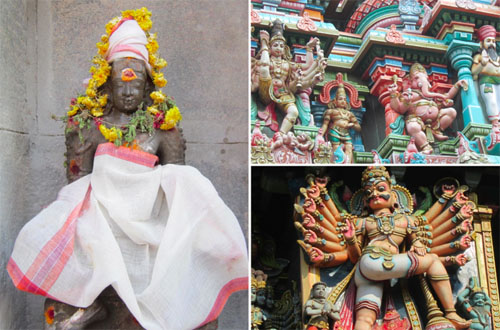
The locals in Madurai consider the Meenakshi temple complex to be the Taj Mahal of Southern India. It is a very large complex of Mayan style architecture (pyramids) that was first built in the first millennium, but whose present carved stone structures were originally built in the fifteenth century. Additional sculptures were added on top of the stone structures in wood and stucco in the seventeenth century.

At a glance from a distance, the temples are amazingly colourful and intricate. It took several questions to our guide to ascertain that the temples are indeed repainted and updated every twelve years and not original pigments from the 1600’s. With this new knowledge, our evaluation and appreciation of the entire complex seemed to lose its luster so to speak.

On closer inspection, the abundant sculptures covering every inch of the structures, all painted in a pastels and “brights” as I would call them, were more akin to a Disney animated movie palate than the spiritual respect that one would expect should be accorded a holy shrine. The sculptures themselves were amazingly Disney like. So much so, that I am quite sure the inspiration for many Disney characters must have originated here.

I had a hell of a time understanding our guide’s English so Google, as always, to the rescue. Here are some facts.

“The enormous temple complex is dedicated to Shiva, known here as Sundareshvara and his consort Parvati or Meenakshi. The original temple was built by Kulasekara Pandya, but the entire credit for making the temple as splendid as it is today goes to the Nayaks. The Nayaks ruled Madurai from the 16th to the 18th century and left a majestic imprint of their rule in the Meenakshi - Sundareswarar Temple.

The temple complex is within a high-walled enclosure, at the core of which are the two sanctums for meenakshi and Sundareshwara, surrounded by a number of smaller shrines and grand pillared halls. Especially impressive are the 12 gopuras. Their soaring towers rise from solid granite bases, and are covered with stucco figures of dieties, mythical animals and monsters painted in vivid colours.

(We also visited) The Thousand Pillar Mandapam is considered the 'wonder of the palace'. Actually the number of pillars count to 985 beautifully decorated columns. Each pillar is sculptured and is a monument of the Dravidan sculpture. There is a Temple Art Museum in this 1000 pillars hall where you can see icons, photographs, drawings, etc., exhibiting the 1200 years old history. There are so many other smaller and bigger mandapams in the temple.

Just outside this mandapam, towards the west, are the Musical Pillars. Each pillar when stuck produces a different musical note. The kalyana mandapa, to the south of the pillared hall, is where the marriage of Shiva and Parvati is celebrated every year during the Chitirai Festival in mid- April.”

The next day we drove a short distance to Trichy, home to the Rock Fort and Ranganathaswamy Temples. We found more of the same there, just without the guide who I couldn’t understand.

Marc and I had mixed feelings about both towns and both temple complexes. The Disney style seemed to us inappropriate for places of worship (very presumptuous of us I know, but that is how we felt), yet the structures and complexes were magnificent in their own strange Indian way. Marc read somewhere that this style of architecture (Dravidan) has been compared to an Indian style Baroque. I think we both agreed that this was an apropos description.

But we will let you make your own decisions. Here are some photos. The first batch are in Madurai,


and these are from Trichy.